


STEM and AI Education in Destin, Florida: How The Barrett School Prepares Students for What Comes Next

Why STEM and AI education in Destin, Florida can't wait until high school
The jobs that will define the next twenty years do not look like the jobs of today. Artificial intelligence is already reshaping medicine, engineering, logistics, finance, and communication and the students entering kindergarten this year will graduate into a workforce where fluency in technology is not an advantage but a baseline expectation. The question for parents in Destin is not whether their child needs STEM and AI education. It is whether their school starts early enough to matter.
At The Barrett School, we do not treat STEM as a subject you add in middle school or a club you join in ninth grade. It is embedded in how we teach from Pre-K3 through 12th grade, across every division, as a natural part of how students learn to think, question, and build.
How STEM is taught at every level of Barrett's programme
In the Early School, STEM begins through the senses. Young learners explore cause and effect through nature-based design challenges, simple machines, and hands-on experiments that connect science to the world directly in front of them. The goal at this stage is not content mastery it is curiosity. A child who asks "why does that happen?" at age five is already thinking like a scientist.
In the Lower School, students move from observation to investigation. They begin structured problem-solving, work with physical building materials, and use early coding tools including Scratch and Micro:bit to see how logic translates into action. These are not enrichment activities. They are core to how reading, maths, and science are delivered.
In the Intermediate School, the complexity increases. Students work in collaborative engineering teams, run experiments with real variables, and begin engaging with the ethical questions that surround technology privacy, bias in algorithms, digital citizenship, and the responsibilities that come with building things that affect other people.
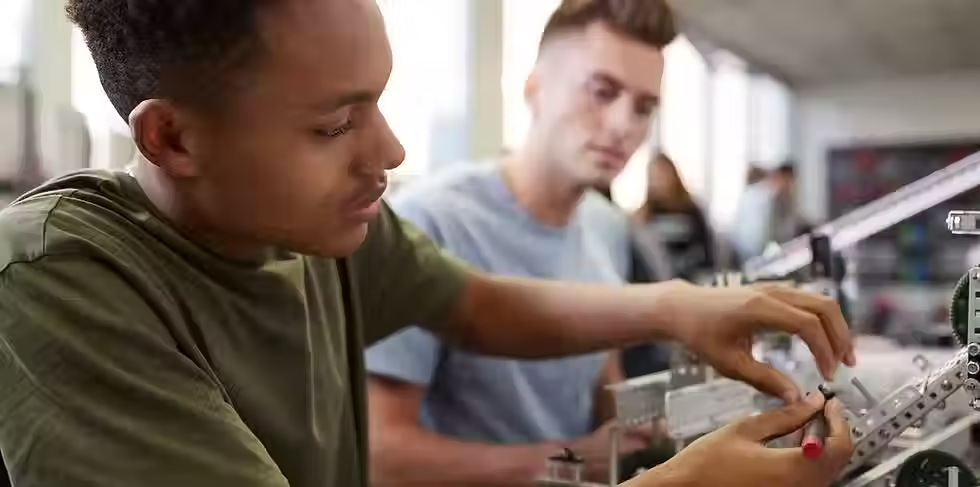
In the Upper School, STEM reaches its full expression. Students have access to dedicated Innovation Labs where they build robots, design solutions to real-world problems, and work through projects from concept to prototype. This is also where Barrett's dual enrollment partnership with Arizona State University and the University of South Florida opens doors to university-level STEM coursework with real transferable credits before a student ever leaves our campus.
AI education at Barrett — what it actually looks like in the classroom
Artificial intelligence is not a single subject at Barrett. It is a lens that runs through how we teach students to engage with information, make decisions, and evaluate outcomes.
In the younger grades, AI concepts are introduced through age-appropriate tools and discussions. Students learn what machine learning is, how algorithms make recommendations, and why data matters. In the older grades, students work with adaptive learning platforms, explore AI-generated outputs critically, and engage in structured discussions about what it means to use technology responsibly.
The goal is not to produce computer scientists, though some students will go on to pursue that path. The goal is to produce graduates who understand the systems shaping their world well enough to participate in them thoughtfully — as users, citizens, creators, and one day, leaders.
What makes Barrett's approach different from other schools in Destin
Most schools in the area introduce technology as a separate period a computer lab rotation, an elective in a later grade, or an after-school club. At Barrett, STEM and AI are not scheduled. They are the method. A science lesson is also a problem-solving exercise. A maths class is also a data literacy exercise. A humanities discussion includes the question of how AI is changing how we read, write, and communicate.
This integration matters because isolated exposure does not build fluency. A student who touches robotics once a week for a semester does not think like an engineer. A student who builds, fails, iterates, and builds again across nine years of schooling does.
Small class sizes of 8 to 12 students make this possible in a way that larger schools cannot replicate. Every student in a Barrett STEM session is an active participant not an observer waiting for a turn.
See it in action
The best way to understand what STEM and AI education looks like at The Barrett School is to come and see it. Our Innovation Labs are open during campus tours, and our teachers will walk you through exactly what students are building, learning, and creating at every grade level.
Schedule a campus visit to see hands-on STEM learning across every division. If you are ready to take the next step, the admissions overview and application process pages have everything you need to get started for the 2026-2027 school year.


Comments